There Was a Time You Got Dressed Up to Board a Plane
There Was a Time You Got Dressed Up to Board a Plane
Picture this: it's 1962. You're flying from New York to Los Angeles on TWA. You've put on your good suit — or your good dress — because that's simply what you do. The cabin is wide enough that you don't feel like you're being stored. A flight attendant, called a stewardess, brings you a proper meal on real dishware. The ticket cost you the equivalent of about $1,200 in today's dollars. And you feel, unmistakably, like you are doing something remarkable.
Now picture the last time you flew. You know how that went.
Flying Was Never Meant for Everyone
Commercial air travel in America's early decades was a genuinely elite experience — not as a marketing strategy, but because the economics demanded it. Operating costs were enormous, routes were limited, and the Civil Aeronautics Board, a federal agency established in 1938, tightly controlled both which airlines could fly which routes and what they were allowed to charge. Fares were high and fixed. Competition was limited by design.
The result was an industry that catered almost exclusively to business travelers and the wealthy. In 1955, fewer than 10 percent of Americans had ever been on a commercial flight. Airlines understood their customer base and served them accordingly — with full meals, generous seat spacing, complimentary drinks, and a level of attentive service that would be unrecognizable today.
Flight attendants were required to meet strict physical standards and were often let go when they married or turned 32. That's a separate and troubling story. But as a byproduct, airlines cultivated a carefully managed image of glamour and exclusivity that reinforced the sense that flying was an event, not a commute.
The Year Everything Changed
October 1978. President Jimmy Carter signed the Airline Deregulation Act, and the entire structure of American commercial aviation began to come apart — deliberately, and with the explicit goal of making flying accessible to ordinary people.
It worked. Within years, new carriers flooded the market. Southwest Airlines, which had been operating only within Texas, expanded nationally. Fares dropped dramatically as airlines competed on price for the first time. Routes that had been locked up by legacy carriers opened to competition. By the mid-1980s, average domestic airfare had fallen by nearly 40 percent in real terms compared to the regulated era.
For millions of Americans who had never flown before, deregulation was a straightforward win. The family vacation by plane, once the exclusive domain of the upper-middle class, became genuinely possible for a much wider slice of the population. Passenger numbers surged. The industry grew explosively.
But something else was happening at the same time.
The Slow Evacuation of the Experience
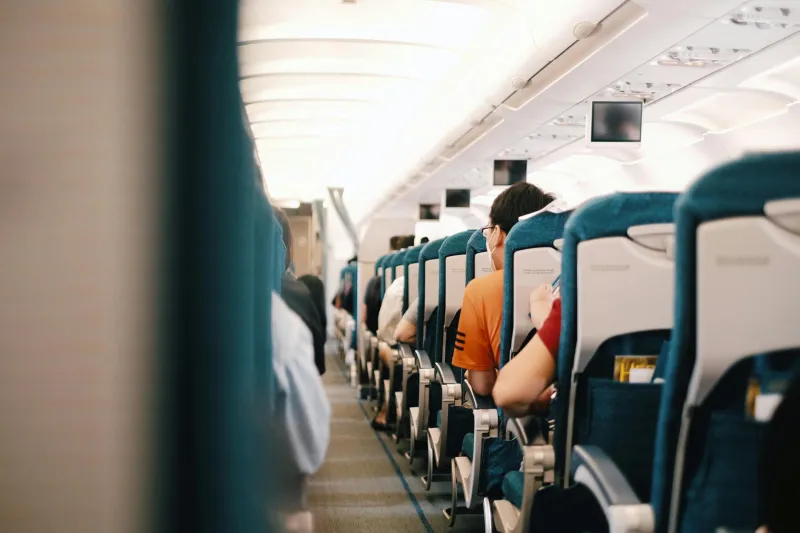
When price became the primary battleground, everything that cost money without generating revenue became a target. Seat pitch — the distance between your seat and the one in front — averaged around 35 inches on domestic flights in the 1970s. Today, many budget carriers offer 28 inches. That's not a minor adjustment. That's a fundamentally different physical experience.
Meals disappeared from short-haul flights in the 1980s and from most domestic routes by the early 2000s. Checked baggage fees, introduced broadly around 2008, turned what had once been a basic expectation into an à la carte add-on. Change fees, seat selection fees, priority boarding fees — the unbundling of the flying experience into individually priced components became the dominant business model.
Airports, meanwhile, evolved into something between a mall and a holding facility. Terminal overcrowding, security lines that didn't exist before 2001, and the general texture of mass-market transit replaced the relatively calm, even stylish airport environments of the earlier era. Flying stopped feeling like a departure from ordinary life and started feeling like an extension of it — just more cramped and more expensive in hidden ways.
The Numbers Tell the Story
In 1965, a round-trip ticket from New York to Los Angeles cost roughly $208 — equivalent to about $2,000 today when adjusted for inflation. The average equivalent fare for that route now runs between $300 and $600, often less if you book early. The price drop is real and substantial.
What changed is what you get for it. In 1965, that $2,000-equivalent ticket included a meal, generous space, and service that airlines actively competed to make memorable. Today's $400 ticket often includes a seat assignment (if you pay extra), a small bag of pretzels, and the opportunity to pay another $35 if you want to bring a suitcase.
In 2023, U.S. airlines carried roughly 900 million passengers. In 1965, the figure was closer to 100 million. The access revolution is undeniable. So is the experience collapse.
Did We Make the Right Trade?
This is where it gets genuinely complicated. Democratizing air travel was a meaningful social achievement. The ability to fly across the country for a few hundred dollars changed what was possible for ordinary American families — where they could go for vacation, how easily they could visit relatives, whether they could afford to take a job offer in another city.
But there's something worth acknowledging in the fact that flying used to feel like something. It carried a sense of occasion that has been almost entirely engineered out of the experience in the name of efficiency and margin.
First class still exists, of course — and for those willing to pay, the service has actually improved dramatically over what the 1960s offered. Lie-flat beds, premium dining, noise-canceling headphones. The split between the flying experience available to the wealthy and the one available to everyone else has arguably never been wider.
The golden age of flying was golden for a very specific group of people. What replaced it serves far more of us — just with considerably less grace.