Everyone on the Block Was Reading the Same Page. Now We're All in Different Books.
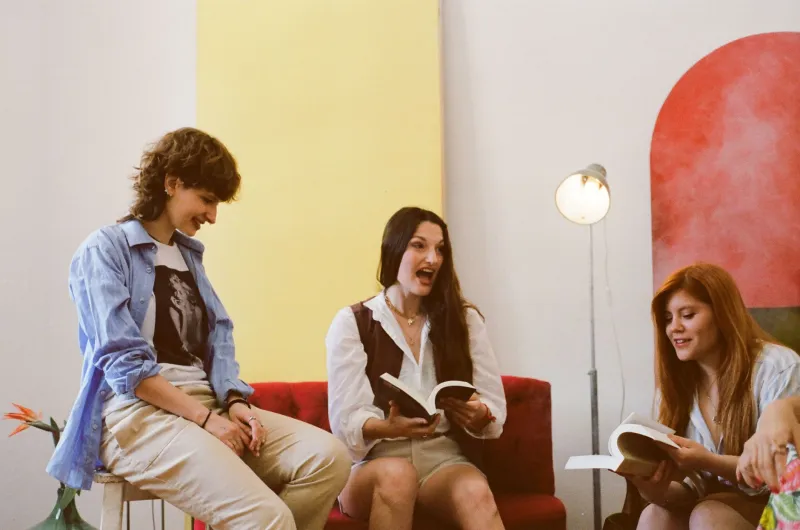
There was a time when finishing a book meant you could talk about it with almost anyone. Not because people were more intellectual or more patient back then — but because there simply weren't that many books competing for everyone's attention at once. The cultural funnel was narrow, and that narrowness created something surprisingly powerful: a shared experience.
Today, that funnel has exploded into a thousand separate streams, each one personalized, optimized, and quietly isolating.
When the Bestseller List Was Everyone's Reading List
Back in the mid-twentieth century, book discovery was a communal exercise. You heard about a novel from your sister-in-law. You saw it face-out at the drugstore. Your pastor mentioned it. The New York Times bestseller list carried real weight — not just as a sales tracker, but as a cultural signal. If a book was on it, chances were good that several people in your orbit had already read it or were about to.
Book clubs in the 1950s, 60s, and 70s weren't niche hobbies. They were neighborhood institutions. Women gathered in living rooms across suburban America to dissect the same chapters over coffee and cigarettes. Men swapped paperbacks at the office. Reading the same thing as your neighbor wasn't a coincidence — it was practically built into the infrastructure of how books moved through society.
Then came Oprah's Book Club in 1996, which took that communal energy and amplified it to a national scale. When Oprah picked a title, millions of Americans bought it the same week. You could walk into any bookstore, any library, any break room in the country and find someone mid-chapter in the same story. It was the last great example of mass reading culture operating at full volume.
The Algorithm Stepped In
Something shifted quietly in the 2010s. Amazon's recommendation engine got smarter. Goodreads started building detailed reader profiles. Then came BookTok on TikTok, Instagram's reading community, and curated email newsletters that promised to match your exact taste. Suddenly, book discovery became intensely personal — and intensely fragmented.
The algorithm doesn't care what your neighbor is reading. It cares what you clicked on last Tuesday at 11pm. It feeds you more of what already interests you, which feels helpful right up until you realize you haven't been surprised by a book in years. You haven't stumbled into a story you wouldn't have chosen for yourself. You've been handed a mirror, not a window.
And here's the thing: two avid readers today — people who both love books, who both spend hours reading every week — can have almost zero literary overlap. One is deep in romantasy series recommended by a 22-year-old influencer. The other is working through a backlist of Scandinavian literary fiction surfaced by a Substack newsletter. Both are having rich reading experiences. Neither has any idea what the other is talking about.
What the Shared Book Actually Gave Us
It's easy to romanticize the old model. Fewer choices meant less noise, sure — but it also meant less diversity. The books that dominated mid-century culture were largely written by and for a pretty narrow slice of America. The shared reading experience was real, but it wasn't equally shared.
Still, something genuinely valuable got lost in the transition. When a community reads the same book, it creates what you might call a common emotional vocabulary. People process the same themes, argue about the same characters, feel moved by the same scenes. That shared texture becomes a kind of social glue — low-stakes, but real.
Think about the last time a single book generated a truly national conversation. Gone Girl in 2012 came close. The Hunger Games crossed a lot of demographic lines. But even those felt like cultural islands compared to the era when The Catcher in the Rye or To Kill a Mockingbird was simply what Americans were reading.
More Choice, Less Conversation
The irony of our current reading moment is that we have access to more extraordinary books than at any point in history. Independent publishers are thriving. Voices that were once locked out of the mainstream are finally finding massive audiences. The sheer breadth of what's available is genuinely exciting.
But breadth comes with a cost. When everyone is reading something different, there's no common text to react against, build on, or argue about. Water-cooler conversations about books have largely disappeared — not because people stopped reading, but because the chances of two coworkers being in the same book at the same time are now remarkably slim.
And the algorithm, for all its cleverness, tends to push us toward comfort rather than challenge. It rarely recommends the book that will unsettle you, the one that comes from a perspective completely unlike your own. That used to happen naturally, because the bestseller list didn't know your taste. It just told you what was selling.
The Page We're All on Now
We're not going back to a world where three publishers and one talk-show host determine what America reads. Nor should we. But it might be worth asking what we want from reading culture beyond the personal — whether there's value in occasionally reading the same thing as the people around us, not because an algorithm decided it was perfect for us, but because it's what everyone else is talking about.
There's something to be said for the book that surprises you. The one you didn't choose. The one your neighbor handed you over the fence and said, just read it.
That recommendation didn't know your data. It just knew you.