When Getting Glasses Meant Playing Twenty Questions With Your Eyes
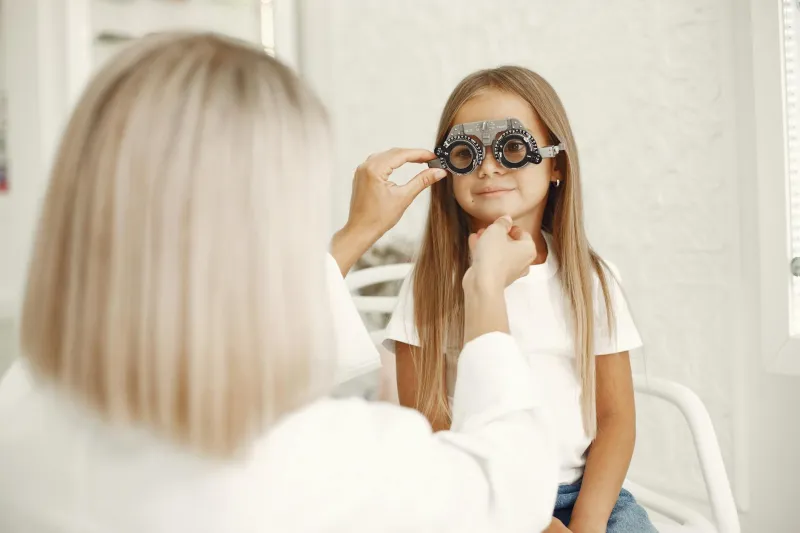
When Getting Glasses Meant Playing Twenty Questions With Your Eyes
Imagine walking into an eye doctor's office where the most sophisticated piece of equipment is a magnifying glass and a handful of thick, chunky lenses that look like they were carved from bottle bottoms. The "eye chart" might be a piece of paper with random letters scrawled in different sizes, and your prescription would be determined by a process that resembled educated guesswork more than medical science.
This wasn't some medieval torture chamber — this was standard eye care for most of the 20th century.
The Dark Ages of Vision Correction
Before the 1950s, getting your eyes examined was an exercise in patience and prayer. The optometrist would hold up various lenses in front of your face, asking the now-famous question: "Better or worse?" The problem was, with limited lens options and crude measuring tools, "better" often wasn't very good at all.
Early eye exams relied heavily on subjective responses. There was no way to measure the exact curvature of your eye or detect subtle vision problems that couldn't be articulated by the patient. If you had astigmatism — a common condition where the eye isn't perfectly round — tough luck. Most eye care providers couldn't even diagnose it properly, let alone correct it.
The lenses themselves were thick, heavy pieces of glass that distorted your peripheral vision and made you look like you were peering through the bottom of a Coke bottle. They were expensive to make, took weeks to arrive, and often didn't match your actual prescription because the measurements were so imprecise.
When Blurry Was Just Life
Here's what's really mind-blowing: millions of people simply accepted poor vision as a fact of life. If the local optometrist couldn't help you see clearly, you just... lived with it. There were no second opinions, no advanced diagnostic tools, and certainly no online vision tests or same-day lens crafting.
Contact lenses existed but were hard, uncomfortable pieces of glass that only the most desperate would wear. They required special solutions, constant maintenance, and often caused more problems than they solved. Most people who tried them gave up within weeks.
For children with vision problems, the situation was even worse. Many eye conditions that we routinely catch and correct today went completely undiagnosed. Kids struggled through school, labeled as slow learners when they simply couldn't see the blackboard clearly.
The Technology Revolution
Fast-forward to today, and the difference is staggering. Modern eye exams use technology that would have seemed like magic to a 1950s optometrist. Automated refraction machines can determine your exact prescription without you saying a word. Digital retinal imaging lets doctors photograph the back of your eye in stunning detail, catching problems years before symptoms appear.
OCT scans can measure the thickness of your retinal layers to the micrometer. Corneal topography maps create a 3D model of your eye's surface, allowing for corrections so precise that many people achieve vision better than 20/20.
The At-Home Revolution
But perhaps the most dramatic change is that you don't even need to leave your house for basic vision correction anymore. Companies like Warby Parker and Zenni Optical have created online vision tests that can generate an accurate prescription using just your smartphone and a computer screen.
These tests use sophisticated algorithms to measure how your eyes track movement, focus on objects at different distances, and respond to various visual stimuli. The accuracy rivals traditional in-office exams for basic prescriptions — something that would have been pure science fiction just 20 years ago.
Same-Day Miracles
Remember when getting new glasses meant waiting 2-3 weeks and hoping they'd actually help you see better? Today, many optical shops can cut your lenses while you wait. Advanced lens-cutting machines can create complex prescriptions with multiple focal points, anti-reflective coatings, and blue light filtering in under an hour.
Contact lens technology has exploded too. Daily disposables mean no cleaning or maintenance. Specialty lenses can correct astigmatism, presbyopia, and even color blindness. Some contacts can monitor your eye pressure or blood glucose levels, turning your eyes into health monitoring stations.
The Precision We Take for Granted
What we consider routine today would have been miraculous to previous generations. Laser eye surgery can reshape your cornea with sub-microscopic precision, often eliminating the need for glasses entirely. Implantable lenses can correct vision problems that were once considered untreatable.
Even basic improvements are remarkable. Today's lens materials are lighter, thinner, and more durable than anything available decades ago. Anti-scratch coatings, UV protection, and glare reduction come standard on most glasses.
The Human Cost of Imprecision
It's easy to forget that poor vision correction wasn't just an inconvenience — it shaped entire lives. People chose careers based on what they could see clearly enough to do. Social interactions suffered when you couldn't recognize faces from across the room. Driving at night was genuinely dangerous for millions of Americans who simply couldn't get the vision correction they needed.
Today, most vision problems are solvable. What once meant a lifetime of squinting and struggling can often be corrected in a single appointment. The transformation from guesswork to precision has given millions of people access to careers, hobbies, and experiences that would have been impossible with the crude vision correction of the past.
The next time you effortlessly order new glasses online or pop in daily contacts without a second thought, remember: you're living in an age of visual miracles that would have seemed impossible to someone peering through those thick, imperfect lenses of yesterday.