A Bad Harvest Once Meant Burying Your Children. Now It Means Switching Brands.
Somewhere in your family tree, there is almost certainly an ancestor who watched a crop fail and understood, with quiet dread, exactly what that meant. Not inconvenience. Not tighter budgets. Death. Possibly their own. Possibly their children's.
That reality is so far removed from modern American life that it barely registers as history. It feels more like myth. But it wasn't myth — it was the baseline human condition for thousands of years, and the fact that it no longer applies to most Americans is one of the most extraordinary shifts the world has ever quietly pulled off.
When the Pantry Was the Whole Plan
For most of American history — and virtually all of human history before that — food was not a given. It was a project. A seasonal, weather-dependent, backbreaking project with no safety net.
In the early 1800s, the majority of Americans were subsistence farmers. That meant you grew what you ate, you ate what you grew, and if something went wrong in between, you went hungry. A late frost in spring, a drought in July, a flood in August — any one of these could wipe out a family's entire food supply before winter arrived.
Winter itself was the real adversary. There were no grocery stores to fall back on, no canned goods shipped in from California, no frozen meals waiting in a humming box in the corner of the kitchen. You ate what you had managed to preserve from the harvest. When that ran out, you made do with less. When less ran out, the consequences were grim.
Historians estimate that food-related mortality — from starvation, malnutrition, and the diseases that prey on weakened bodies — was a routine feature of life in early America, particularly in harsh winters and years of crop failure. The Irish Potato Famine of the 1840s, which drove millions of immigrants to American shores, was a vivid and recent reminder to an entire generation of what a single failed harvest could do at scale.
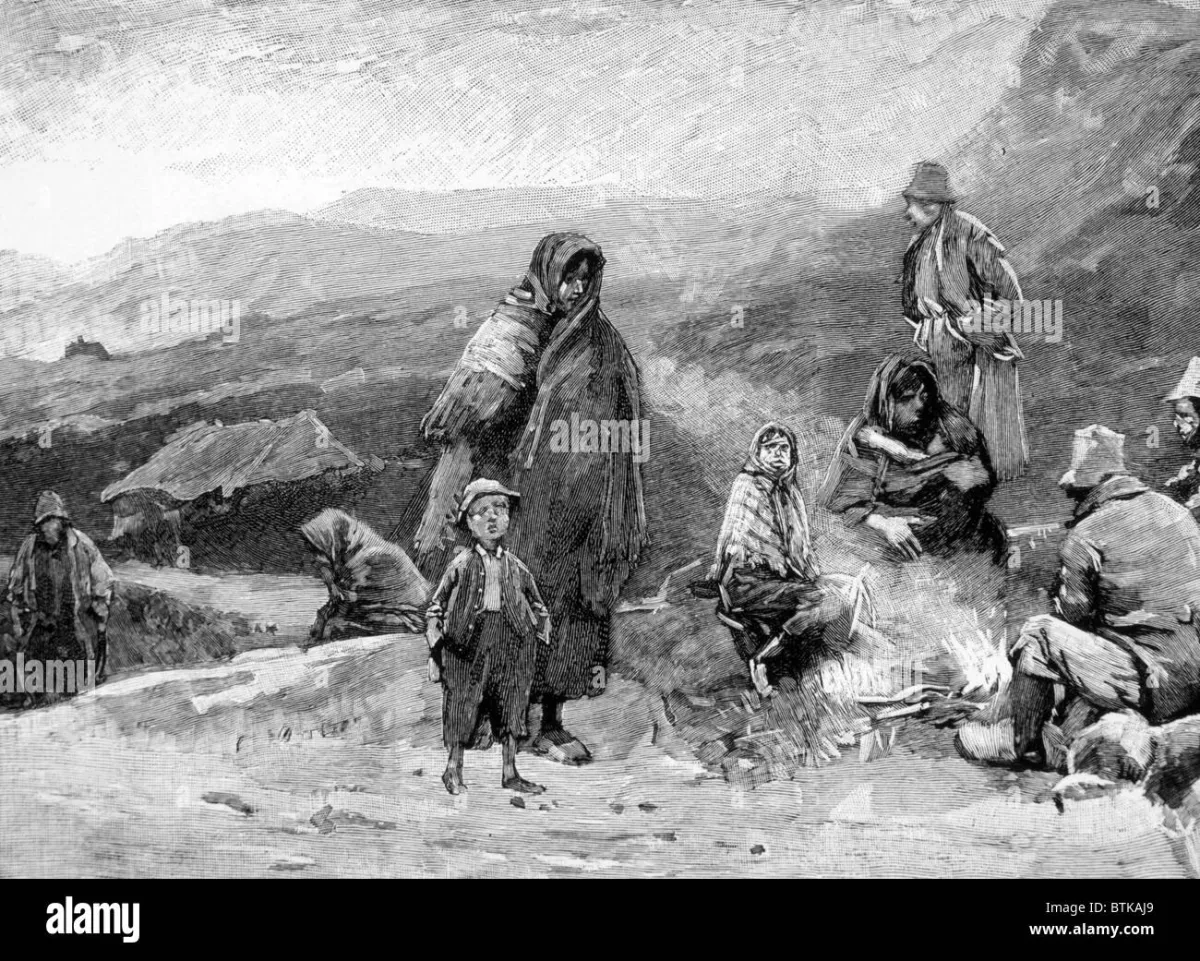 Photo: Irish Potato Famine, via c8.alamy.com
These weren't distant tragedies. They were living memory, passed down at kitchen tables and in church pews.
The Machinery That Changed Everything
The transformation didn't happen overnight, and it didn't happen because of any single invention. It was a slow-building cascade.
First came mechanized farming in the mid-to-late 1800s. The steel plow, the mechanical reaper, and eventually the combine harvester meant that a single farmer could cultivate land that would have required dozens of workers a generation earlier. Yields grew. Surpluses became possible.
Then came refrigeration. The ability to keep food cold — first through commercial ice houses, then through mechanical refrigeration in the early 20th century — meant that food could be stored and transported over distances and timeframes that had previously been impossible. A farmer in Iowa could now feed someone in New York. Produce that would have rotted within days could survive weeks.
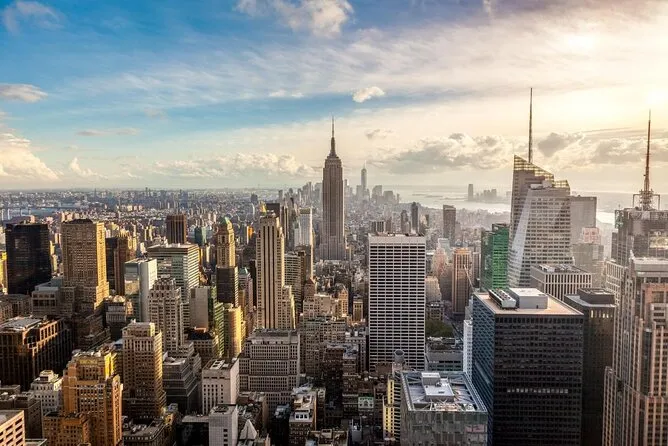 Photo: New York, via media.tacdn.com
The railroad and later the trucking industry turned that possibility into reality. By the mid-20th century, a national food distribution network was in place, one that could move food from where it was grown to where it was needed with a speed and reliability that would have seemed like science fiction to a 19th-century farmer.
Finally, the rise of industrial agriculture after World War II — synthetic fertilizers, pesticides, hybrid crop varieties, and eventually genetically modified organisms — pushed yields to levels that would have been literally unimaginable to previous generations. The United States went from a country that feared famine to the world's largest food exporter.
What "Food Insecurity" Means Now vs. Then
Here's where the contrast becomes almost uncomfortable to sit with.
Today, when Americans talk about food insecurity, they are describing something real and serious — roughly 44 million Americans, including 13 million children, face uncertainty about where their next meal is coming from. That number matters and shouldn't be minimized.
But even that modern definition of food insecurity is categorically different from what the phrase would have meant to a frontier family in 1830. Today's food-insecure American lives in a country with 38,000 food banks and pantries, federal nutrition assistance programs serving tens of millions of households, and grocery stores that throw away more food every single day than many 19th-century towns consumed in a week.
For the average middle-class American today, a "bad year" in food terms means choosing the store-brand pasta instead of the imported Italian kind. It means skipping the organic section. It means meal planning a little more carefully. The existential terror that once accompanied a failed harvest — the kind that kept people awake in October wondering if their children would survive until April — is simply not part of the equation.
Even the relationship with seasons has evaporated. Your great-great-grandmother ate what was available in her region, in her season, period. You can buy strawberries in January, asparagus in November, and mangoes in Minnesota in February. The global supply chain has effectively abolished the agricultural calendar for American consumers.
What We Lost When We Stopped Being Afraid
There's something worth pausing on here, beyond the obvious celebration of progress.
When food required genuine effort, sacrifice, and risk, people related to it differently. Wasting food wasn't a minor guilt — it was a moral failing, sometimes a dangerous one. Meals weren't just fuel; they were the product of months of labor and worry. Families gathered to eat not because someone read an article about the importance of dinner rituals, but because the meal itself represented survival.
The modern American relationship with food — abundant, cheap, convenient, and often taken entirely for granted — is the product of an almost miraculous chain of agricultural and logistical innovation. It is, by any historical measure, an astonishing achievement.
But somewhere in that abundance, something was also quietly lost: the understanding that food is not guaranteed. That the systems delivering it are complex and fragile in ways we rarely think about. That the distance between plenty and shortage, while vast today, has been crossed before.
Your ancestors knew that in their bones. Most of us have the luxury of never having to think about it at all.