One Job, One Company, One Life — The Career Path That No Longer Exists

Picture this: a man walks into a company at age 22, learns the ropes, earns steady promotions, retires at 65, and spends his final working day shaking hands with people who have known him for four decades. His children grow up knowing exactly what Dad does, where he goes every morning, and roughly what the future looks like.
That image isn't a fantasy. For a significant chunk of 20th-century America, it was just Tuesday. And for most people under 45 today, it sounds like a story from another planet.
The Era of the Lifetime Employer
The postwar American economy — roughly the 1950s through the early 1980s — was built around a particular compact between employers and workers. Companies offered stability, benefits, pensions, and a predictable ladder. Workers offered loyalty, consistency, and the implicit promise that they wouldn't leave for a competitor.
This wasn't just cultural sentiment. It was economically rational on both sides. Companies invested heavily in training employees because they expected to keep them. Workers accepted modest wages in early years because they trusted the long-term payoff. The whole system ran on a kind of mutual faith that both parties would honor the deal.
For blue-collar workers, the union reinforced this structure. For white-collar employees, it was embedded in corporate culture — the idea that a company was something you belonged to, not just somewhere you happened to be working right now.
A 1970s survey of American workers found that the average person expected to hold two or three jobs in their lifetime. Not two or three careers. Two or three jobs, total. The idea of voluntarily leaving a stable employer to try something entirely different wasn't just uncommon — it was considered slightly suspect. What was wrong with you that you couldn't hold a position?
When the Compact Broke
The shift didn't arrive with a single announcement. It crept in through a series of economic earthquakes that shook the ground beneath the old system.
The recession of the early 1980s introduced mass layoffs at a scale that American corporate culture hadn't normalized before. Companies that had prided themselves on never letting people go discovered that Wall Street rewarded workforce reductions with higher stock prices. The lesson was absorbed quickly and never forgotten.
 Photo: Wall Street, via wallpaperaccess.com
Then came the technology wave. The personal computer, and later the internet, didn't just create new industries — they obliterated old ones with startling speed. Entire job categories that had seemed permanent fixtures of the American economy simply ceased to exist. Travel agents. Typesetters. Film processors. Switchboard operators. Workers in their 40s and 50s who had done the same job for twenty years found themselves holding skills that the market no longer valued.
Globalization added another layer. Manufacturing jobs that had anchored working-class careers for generations moved overseas. The factory floor that had employed a man's father and grandfather was gone, and no loyalty or tenure could bring it back.
By the 1990s, the old compact was effectively dead — not announced, not mourned publicly, just quietly retired. Companies began framing layoffs as "restructuring" and "right-sizing," language designed to make the elimination of people sound like a management strategy rather than a broken promise.
The New Normal: Career as a Choose-Your-Own-Adventure
Today, the Bureau of Labor Statistics estimates that the average American holds twelve different jobs between the ages of 18 and 54. Twelve. And that number is widely considered an undercount, since it doesn't fully capture freelance work, gig economy roles, or the growing number of people who run side businesses alongside traditional employment.
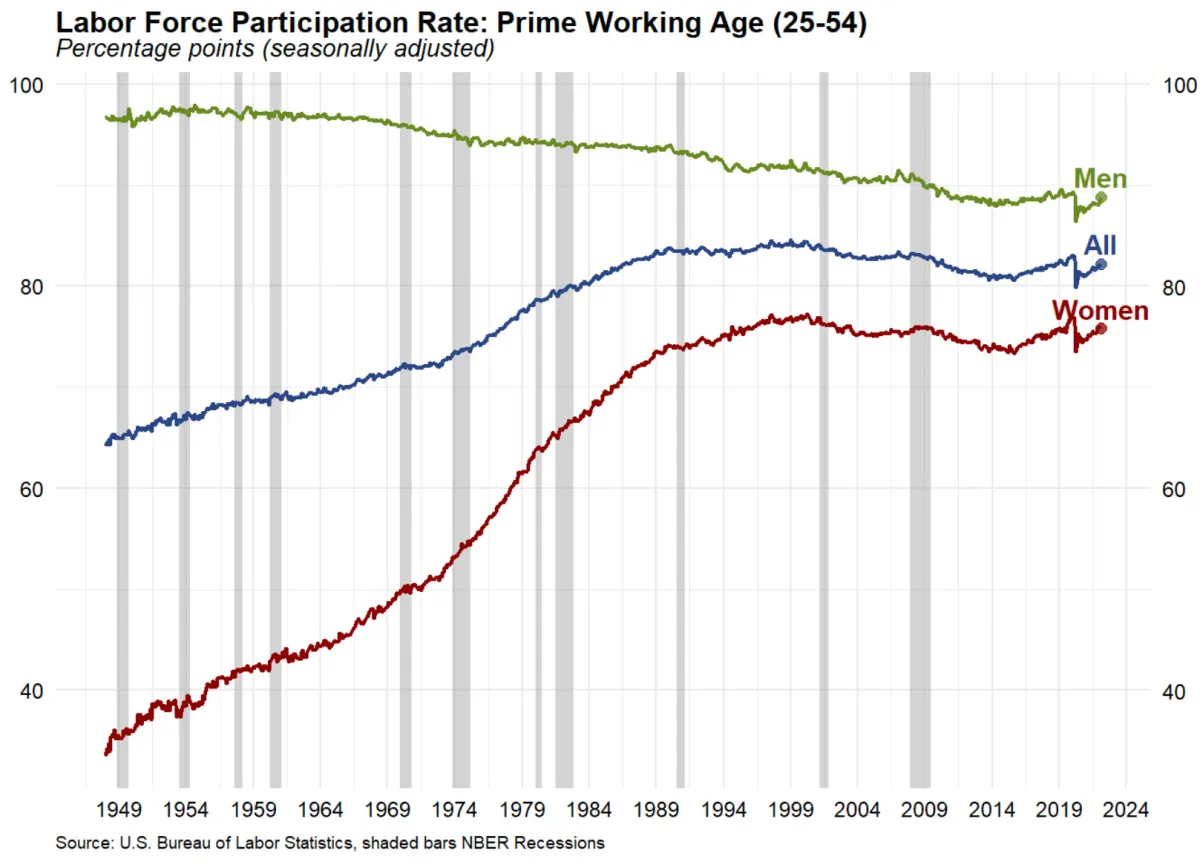 Photo: Bureau of Labor Statistics, via www.cfholbert.com
More striking than the number is the variety. It's no longer unusual for someone to spend their twenties in marketing, pivot to tech in their thirties, launch a small business in their forties, and reinvent themselves again before they're fifty. What previous generations would have called instability, this generation calls a portfolio.
The vocabulary itself has shifted. Nobody talks about "climbing the ladder" with quite the same conviction anymore — partly because the ladder keeps getting restructured, and partly because many people have decided they'd rather build their own. "Personal brand," "pivot," "side hustle" — these are the terms of a workforce that has internalized the idea that no employer will protect you, so you'd better protect yourself.
LinkedIn, which didn't exist until 2003, now has over 200 million American users maintaining rolling resumes that document not one career arc but several overlapping ones. The platform is essentially a monument to the death of the lifetime employer.
What Was Lost, and What Was Built in Its Place
The old system had real virtues that tend to get glossed over in celebrations of modern flexibility. Stability meant something. Knowing where you'd be in ten years wasn't boring — it was a foundation. People built lives, families, and communities on the assumption that their professional footing was solid.
The anxiety that characterizes modern career life — the constant resume-polishing, the networking, the fear of being made redundant by an algorithm or a quarterly earnings call — is not a small thing. It's a chronic low-grade stress that previous generations largely didn't carry.
But the new landscape has opened doors that the old one kept firmly shut. People who were miserable in careers they'd stumbled into at 22 can now leave without social stigma. Industries that didn't exist a decade ago are full of people who reinvented themselves to get there. The rigid hierarchies that locked talented people out based on who they knew or what school they attended have been partially — not fully, but partially — disrupted.
Your grandfather's career was a single, straight road. Yours looks more like a hiking trail — unexpected turns, occasional backtracking, and views you never would have seen if you'd stayed on the highway.
Whether that's progress depends a lot on how much you enjoy the hike.