One Phone, One Cord, One Household — And Somehow It Was Enough
One Phone, One Cord, One Corridor — And Somehow It Was Enough
There was a phone in the hallway. Maybe on the kitchen wall. Maybe on a small table near the front door with a notepad beside it and a pen on a little string. One phone. One number. One cord that stretched just far enough to let you duck around the corner for a shred of privacy if you were lucky.
Every person in the house used it. Every call came into the same place. If you were out, you missed it. If someone else was on it, you waited. If the line was busy, the person calling you just had to try again later.
And somehow — improbably, almost incomprehensibly by today's standards — that was fine.
The Rotary Phone as Family Institution
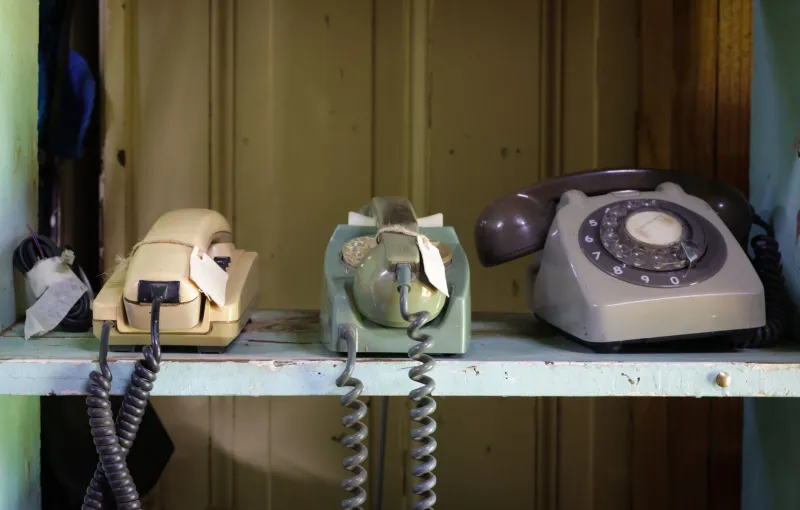
The single household telephone wasn't just a communication device. It was a piece of social infrastructure, as central to mid-century American domestic life as the kitchen table or the front porch. When it rang, everyone in the house heard it. When you answered it, you were representing the household — which meant you spoke differently than you might today, more formally, more consciously. "Johnson residence" was a real thing people said without irony.
The rituals around the phone were genuine rituals. You didn't just call someone — you called their house. You might get their mother, their kid brother, their roommate. You exchanged pleasantries. You explained who you were. You asked if so-and-so was available. There was a whole social choreography involved in making a phone call that has entirely vanished.
Party lines — where multiple households shared the same telephone line — were common well into the 1950s and even the 1960s in rural areas. You'd pick up the phone and someone from down the road might already be on it. You'd wait. You'd listen, if you were the type (and plenty of people were). Privacy was a relative concept. Communication was, by its nature, communal.
The busy signal deserves its own moment of recognition. That rhythmic double-beep that told you someone was already on the line — it was a form of information that carried real emotional weight. It meant the person you wanted to reach was there, was reachable, was alive and talking to someone. You'd try again in ten minutes. Maybe twenty. The waiting was part of the process.
When Missing a Call Actually Meant Missing Something
Here's a thing that's genuinely hard to explain to anyone under 35: the particular anxiety of possibly having missed an important call.
There was no voicemail until the 1980s, and it didn't become widespread until later than that. Before answering machines became common, a missed call was simply gone. If someone called while you were at the grocery store, that conversation didn't happen. They'd call back, or they wouldn't. You'd find out eventually, or you wouldn't. The uncertainty was just a feature of daily life that people had learned to live with.
Answering machines, when they arrived, felt like genuine magic. The idea that a device could hold a message for you — that someone's voice could wait for you in a little box on the counter — was remarkable enough that people talked about it. Your grandmother probably described her first answering machine the way people now describe getting their first smartphone.
What Four Devices in One House Actually Cost Us
The average American household today contains somewhere between three and five internet-connected devices capable of making phone calls. A family of four almost certainly has four separate phone numbers, four separate text threads, four separate voicemail boxes. Each person is individually reachable at all times, by anyone, for any reason.
This is an extraordinary thing. It is also, in ways that are hard to articulate but easy to feel, a loss.
When everyone had their own phone, the shared household line disappeared. And with it went the accidental conversations — the times you'd answer for your teenager and end up talking to their friend for five minutes before handing over the receiver. The times your parents would overhear enough of a call to ask about it later at dinner. The small, involuntary moments of connection that happened simply because communication was a shared resource.
Now, communication is private by default. Your teenager's entire social world lives in a device you never touch, in apps you might not recognize, in conversations you'll never accidentally overhear. This is, depending on your perspective, either appropriate independence or a quiet form of fragmentation that nobody quite signed up for.
There's also something to be said about presence. When there was one phone and it rang, everyone in the house knew about it. The call was an event. Now, a person can receive and send dozens of messages in the middle of a family dinner and the only sign is the faint glow of a screen under the table. The phone is everywhere and nowhere. It's personal and constant and somehow less connected than that single rotary unit mounted on the kitchen wall.
The Cord That Held Things Together
Nostalgia is a tricky thing, and it would be dishonest to pretend the old system was better in any practical sense. It wasn't. The convenience of individual mobile phones is real and significant. The ability to reach the person you actually want to talk to, directly, immediately, without negotiating with their family first — that's not nothing.
But culture isn't only about convenience. It's about the habits and rituals that shape how people relate to each other. And the shared household telephone, for all its limitations, created a kind of enforced communal awareness that we traded away without fully realizing what the trade involved.
Somewhere right now, in a house with four phones and a dead-silent dinner table, a teenager is texting someone who's sitting twelve feet away. The irony is almost too neat to be real.
But the rotary phone on the kitchen wall — the one everyone shared, the one you had to wait your turn to use — it kept people in the same story, even when they didn't want to be. That turned out to matter more than anyone thought it would.