Pin the Tail on the Donkey Used to Be Enough. Now There's a Venue, a Theme, and a Swag Bag.
Pin the Tail on the Donkey Was Enough. Now There's a Venue, a Theme, and a Swag Bag.
Ask anyone over 40 to describe their childhood birthday parties and the details come quickly: a grocery store cake with those thick sugary roses, a handful of kids from the neighborhood, maybe a relay race in the backyard. A parent ran the whole thing. It lasted two hours, max. Everybody went home tired and happy, and nobody photographed it for public consumption.
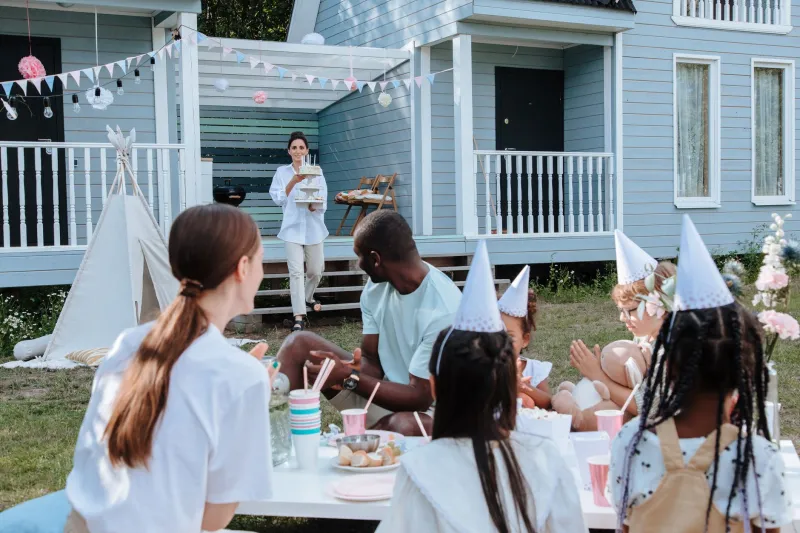
Now ask a parent of a seven-year-old what they're planning for the upcoming birthday. There's a decent chance the answer involves a venue deposit, a theme that required three Amazon orders, a custom balloon arch, a hired entertainer, a grazing table, and individually assembled goody bags with items chosen to reflect the child's current interests. The party might run four hours. It will almost certainly be documented in detail.
This is not a minor lifestyle shift. It's a complete reimagining of what a child's birthday celebration is supposed to be — and more interestingly, what it's supposed to say.
How It Used to Go
The American children's birthday party, for most of the 20th century, was a casual, low-stakes affair. It existed primarily in the domestic sphere — the kitchen, the backyard, the living room with the furniture pushed aside. Mom organized it. Dad maybe set up the sprinkler. The guest list was whoever lived nearby and went to the same school.
The games were standardized and required almost no preparation: Pin the Tail on the Donkey, Musical Chairs, Hot Potato. The cake came from the local supermarket bakery or was made at home from a boxed mix. Party favors, if they existed at all, were a piece of cake wrapped in a napkin to take home. The whole enterprise cost somewhere in the range of what a family might spend on a nice dinner out.
There was no pressure to be original. Nobody was trying to outdo the party from three weeks ago. Children weren't comparing their experiences in any organized or documented way. The point of the party was to celebrate the kid, eat some cake, and let a group of children run around until they were collected by their parents.
That simplicity wasn't poverty. It was the cultural norm across income levels. Even families with means didn't typically transform a seven-year-old's birthday into a production. The elaborate children's party was reserved for the very wealthy — and even then, it wasn't the Instagram-ready spectacle it has become today, because Instagram didn't exist and neither did the social pressure it generates.
The Gradual Escalation
The shift didn't arrive in one moment. It built incrementally over several decades, pushed along by a mix of economic, cultural, and technological forces that each added a new layer to the expectation.
The growth of the party supply industry through the 1980s and 90s made themed decorations cheap and widely available. Chuck E. Cheese and similar venue concepts emerged, offering parents a ready-made party environment that removed the planning burden but introduced the idea that a birthday required a dedicated space outside the home. The party entertainment industry — magicians, face painters, bounce house rental companies — professionalized what had previously been an informal domestic activity.
Then social media arrived, and everything accelerated. Pinterest boards filled with styled party setups. Instagram accounts dedicated entirely to children's birthday aesthetics gathered hundreds of thousands of followers. The beautiful party became a content format, and once it became a content format, it became a competitive space. Parents who had no particular interest in one-upping their neighbors found themselves absorbing a steady visual feed of elaborately staged celebrations and quietly recalibrating what "normal" looked like.
By the early 2020s, surveys were finding that American parents were spending an average of $300 to $500 on a child's birthday party — with significant numbers reporting costs well above $1,000. Party planning services for children had become a legitimate industry segment. Venues specifically designed to host children's events proliferated in suburban strip malls across the country.
What's Really Being Celebrated
Here's where it gets interesting — and a little uncomfortable. Because the question of why children's birthday parties became so elaborate doesn't have a simple answer, and the simple answers that get offered most often aren't entirely satisfying.
It's easy to blame social media, and it's not wrong to note its role. But the escalation was underway before the smartphone era, and it reflects something deeper than the desire for likes. A lot of it connects to the broader transformation of parenting culture that began in the late 1980s and gathered momentum through the 90s and 2000s — the shift toward intensive, highly managed, achievement-oriented parenting that researchers like sociologist Annette Lareau have documented in detail.
In that parenting framework, a child's birthday party is not just a party. It's an expression of how much you value your child, how attentive you are to their interests and preferences, how capable you are of delivering an exceptional experience. The quality of the celebration becomes, in a subtle but real way, a reflection of the quality of the parent. And in a culture that has elevated parenting to an identity rather than a role, the stakes of that reflection are high.
There's also an anxiety dimension that doesn't get discussed enough. Many parents today are raising children in social environments where comparison is constant and highly visible. The child who comes home from a spectacular party at a themed venue and then attends a backyard gathering two weeks later is making comparisons. Parents know this. Some of the escalation is simply a defensive response to that awareness.
The Two-Hour Party's Quiet Legacy
None of this means the elaborate modern party is wrong, or that the parents who throw them are doing something harmful. Kids generally love them. The memories made at a well-executed themed party are real and often vivid.
But there's something worth noticing in the contrast between then and now. The two-hour backyard party with the grocery store cake and the chaotic game of freeze tag didn't require a budget, a planner, or a content strategy. It required a parent willing to show up, a few kids willing to play, and a cake that tasted good even when the frosting was slightly lopsided.
The children at those parties didn't feel uncelebrated. They felt like the day was theirs. Which, it turns out, was the whole point.