Kids Once Vanished Into the Neighborhood Until Dark. Now the Neighborhood Fits in Your Pocket.
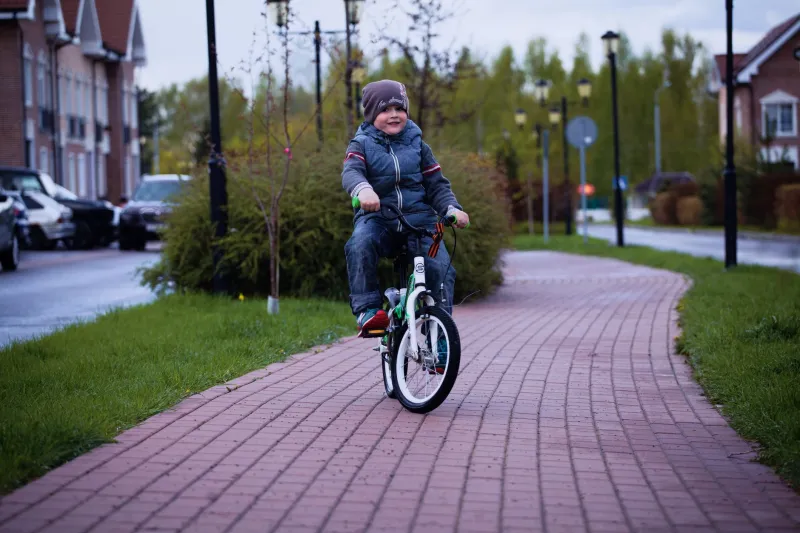
Somewhere around 1985, a nine-year-old could leave the house after breakfast and not be seen again until the smell of dinner drifted through a screen door. Nobody knew exactly where they were. Nobody needed to. The kid would turn up eventually, grass-stained and sunburned, with a story about something that happened at the creek or the empty lot or the far end of the subdivision.
This was not neglect. This was Tuesday.
Parenting in America today operates on entirely different assumptions. The technology exists to know where your child is at every moment of every day, and for a growing number of families, not using that technology feels less like respecting a child's independence and more like leaving something important undone. The invisible umbilical cord — phone in pocket, location shared, find-my-app running — has quietly become the default setting of American childhood.
How we got here is a story about technology, fear, and a cultural shift in what we think childhood is actually for.
What Freedom Actually Looked Like
If you grew up in the late 1970s, '80s, or early '90s, the geography of your childhood was probably defined by how far your legs could carry you. Kids had territories — the park, the school grounds, a friend's backyard three blocks over, the strip mall with the arcade. Parents had a rough mental map of where you tended to go, and that was considered sufficient.
Communication was not continuous. If something went wrong, you found an adult, or a phone — and phones were attached to walls, which meant finding a house where someone was home. If you were going to be late, you called from wherever you were, or you didn't call, and you dealt with the consequences when you got home.
This wasn't a failure of parenting. It was the infrastructure of the time. And within it, kids developed something that child development researchers now talk about with a kind of wistfulness: unsupervised time. Time to make decisions, resolve conflicts, get bored and invent something to do, take small risks, fail at things without an adult watching.
The research on this is fairly consistent. Unstructured, independent play is associated with better problem-solving, stronger social skills, greater resilience, and lower rates of anxiety in adulthood. The freedom that looked casual was actually doing important developmental work.
Then the Fear Arrived
The shift didn't happen because of smartphones. It started before that.
The 1980s brought a wave of high-profile child abduction cases that received saturation media coverage. The face of Etan Patz on a milk carton. Adam Walsh. The launch of the National Center for Missing and Exploited Children in 1984. The message absorbed by a generation of parents was that the world was dangerous in ways it hadn't been before — that children left unsupervised were children at risk.
Here's what the data actually shows: stranger abduction of children is, and was, extraordinarily rare. The rate of violent crime in the United States peaked in the early 1990s and has fallen dramatically since. By most objective measures, American children today are safer from violent crime than they were when their parents were roaming the neighborhood freely. But perception and statistics are different things, and what a culture feels to be true shapes behavior more than what the numbers say.
Parents who grew up in the '80s absorbing those fear messages became the parents of the 2000s and 2010s — and they brought the anxiety with them.
The Phone Made It Permanent
Smartphones didn't create parental anxiety. They gave it a tool.
When iPhones became mainstream around 2008 and kids started carrying phones in middle school — then elementary school — the possibility of constant contact became a reality. And once the possibility existed, the expectation followed. A parent who could know where their kid was at 3pm on a Wednesday but chose not to started to feel, in the cultural atmosphere of the 2010s, like a parent who was opting out of a reasonable precaution.
Apps like Life360, Google Family Link, and Apple's built-in location sharing turned continuous tracking into a normal feature of family life. By 2020, surveys suggested that the majority of American parents with children under 18 used some form of location monitoring. Some kids carry dedicated GPS trackers. Some parents receive alerts when their teenager's car exceeds a certain speed.
The technology works. Kids are reachable. Parents feel better. And something else is quietly happening.
What Gets Lost When Nothing Is Unsupervised
Child psychologists have been raising flags about this for years, and the picture that's emerging isn't simple.
Kids who are constantly tracked often know they're constantly tracked — and they behave accordingly. The psychological experience of being watched is different from the experience of being trusted. Some researchers draw a connection between the decline of unsupervised childhood and rising rates of adolescent anxiety and depression, which have increased sharply over the same period that smartphones became ubiquitous. Correlation isn't causation, but the timing is hard to ignore.
There's also the question of what independence actually means if it's always conditional on a parent's ability to check in. A teenager who knows their location is visible at all times isn't practicing autonomy — they're practicing the appearance of it. The negotiation between a kid and the world, the experience of being genuinely on your own and figuring something out, gets compressed or eliminated entirely.
And then there's the simple math of time. Kids who are trackable are also reachable, which means they're interruptible, which means the experience of being truly away — of entering your own world for a few hours — is harder to come by.
Neither Side Is Entirely Right
This isn't a clean story where one era was obviously better. Kids in the free-range 1980s did get hurt in ways that could have been prevented. Cars were less safe. Bike helmets were rare. Some of the supervision that's expanded since then reflects genuine improvements in child safety, not just parental overreach.
And the technology itself isn't the villain. A kid who gets hurt in a park can now reach a parent instantly. A teenager who ends up somewhere they shouldn't be can ask for help without shame. The same phone that tracks a child can also be a genuine lifeline.
But the balance has shifted so dramatically, so quickly, that it's worth pausing to ask what we're trading away. The generation of kids growing up today will be the first in American history for whom genuine unsupervised childhood — the kind where you're just gone for a few hours and nobody knows exactly where — will be a foreign concept rather than a defining memory.
Whether that makes them safer, or just more watched, is a question American families are still figuring out. The streetlights still come on at dusk. But now there's an app that tells you the kid is already home.